Transform Your World with Language Learning at Glossart Languages!





Franco-Italian: The Forgotten Medieval Language Behind Marco Polo | Glossart Languages
Discover the fascinating story of Franco-Italian, the forgotten medieval literary language that blended Old French and Italian and preserved Marco Polo's legendary travels across Asia
Evangelia Perifanou
7/28/20263 min read
Franco-Italian: The Forgotten Medieval Language Behind Marco Polo's Travels | Glossart Languages
Learning a language often means discovering the history of the people who spoke it. Throughout history, languages have constantly influenced one another, creating fascinating linguistic bridges between cultures.
One of the most remarkable but largely forgotten examples is Franco-Italian, a medieval literary language that blended Old French and northern Italian dialects. Although it disappeared more than five hundred years ago, Franco-Italian played a crucial role in European literature and gave the world one of its greatest travel books: Marco Polo's The Travels (Il Milione).
Understanding Franco-Italian helps us appreciate how languages evolve through cultural exchange and why multilingualism has always been part of European history.
What Was Franco-Italian?
Franco-Italian (also called Franco-Venetian) was not a language that people spoke in everyday life. Instead, it was a literary language used mainly in northern Italy between the 13th and 15th centuries.
Rather than following fixed grammatical rules, it combined:
Old French vocabulary
Northern Italian dialects, especially Venetian and Lombard
Italian spelling and pronunciation
French literary style
Every manuscript was slightly different, making Franco-Italian a flexible written language rather than a standardized one.
Why Did Franco-Italian Develop?
To understand why Franco-Italian appeared, we need to look at medieval Europe.
During the Middle Ages, Old French was one of Europe's most prestigious literary languages. Chivalric romances, heroic epics, and stories about King Arthur and Charlemagne circulated throughout the continent in French.
At the same time, northern Italy was one of Europe's wealthiest commercial regions. Cities such as Venice, Genoa, Pisa, and Milan maintained close commercial and cultural ties with France.
Italian writers wanted their works to reach readers across Europe. Writing entirely in Italian limited their audience, while writing in perfect French was often difficult. The solution was a literary language that combined both traditions.
Franco-Italian became that bridge.
Marco Polo and Rustichello da Pisa
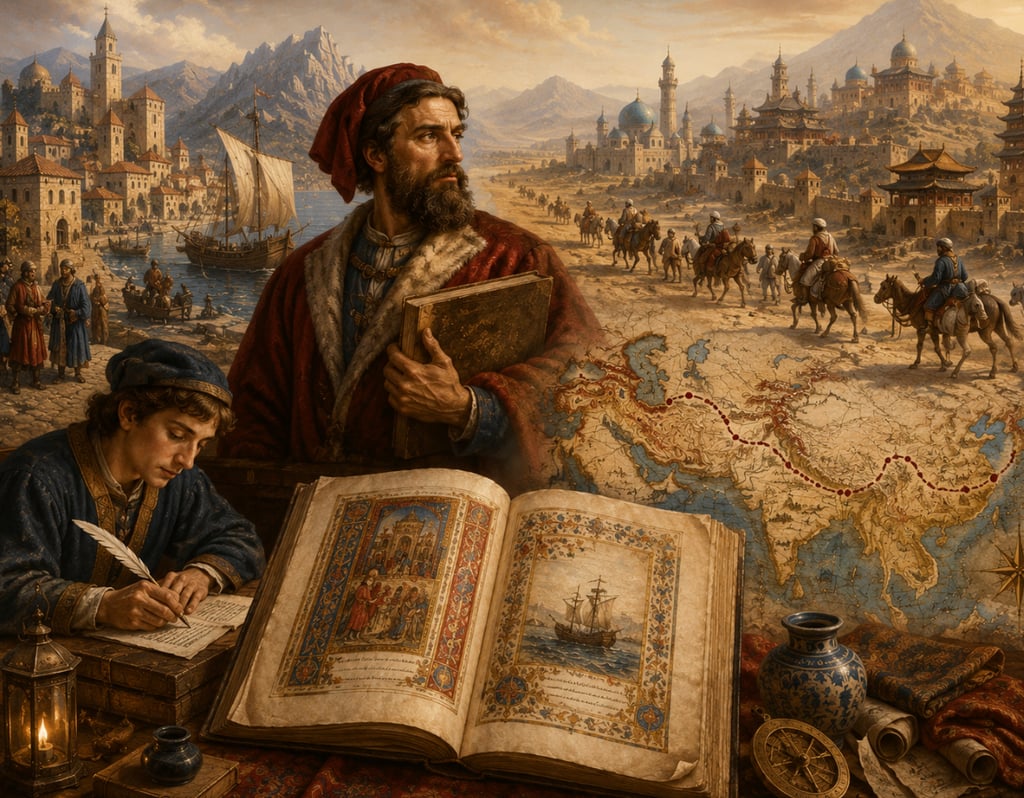
The best-known work written in Franco-Italian is The Travels of Marco Polo.
Around 1298, Marco Polo was captured after the Battle of Curzola and imprisoned in Genoa. There he met Rustichello da Pisa, an experienced author of chivalric romances.
During their imprisonment, Marco Polo narrated the extraordinary stories of his journeys through Persia, Central Asia, China, and the court of Kublai Khan.
Rustichello transformed these oral accounts into a captivating book written in Franco-Italian.
Without Rustichello's literary talent and the widespread appeal of Franco-Italian, Marco Polo's adventures might never have reached readers across medieval Europe.
What Kind of Literature Was Written in Franco-Italian?
Franco-Italian became especially popular for works intended for an international audience.
Among them were:
Arthurian legends
Charlemagne and Roland epics
Chivalric romances
Adventure stories
Travel literature
These works combined French literary traditions with Italian storytelling, making them accessible to readers across different regions of Europe.
Why Did Franco-Italian Disappear?
Like many literary traditions, Franco-Italian gradually disappeared as Europe changed.
Several important developments explain its decline.
Italian Became a Prestigious Literary Language
Writers such as Dante Alighieri, Francesco Petrarca, and Giovanni Boccaccio proved that Italian could produce literature equal to any written in French.
Their works established Tuscan Italian as the foundation of modern Italian.
The Renaissance Encouraged National Languages
During the Renaissance, scholars increasingly preferred writing in classical Latin or refined Italian rather than hybrid literary languages.
The Printing Press Favored Standardization
After the invention of printing, publishers needed consistent spelling and grammar.
Because Franco-Italian had no official rules and varied from manuscript to manuscript, it gradually became impractical for printed books.
Readers Preferred Their Native Language
As literacy increased, people increasingly wanted to read books written in their own language instead of a literary hybrid.
By the late fifteenth century, Franco-Italian had almost completely disappeared.
What Is Franco-Italian's Legacy?
Although it survived for only about two centuries, Franco-Italian left a lasting mark on European culture.
Its legacy includes:
preserving medieval French literary traditions in Italy
connecting French and Italian cultures
helping spread Marco Polo's travels across Europe
demonstrating how languages evolve through cultural contact
It reminds us that linguistic exchange has always been one of Europe's greatest strengths.
Why Does Franco-Italian Still Matter?
At first glance, Franco-Italian may seem like nothing more than a historical curiosity.
In reality, it offers an important lesson about language learning.
Languages are never isolated. They constantly borrow vocabulary, grammar, writing styles, and cultural ideas from one another.
Just as English today functions as an international language in many fields, Old French once fulfilled a similar role across medieval Europe. Franco-Italian emerged naturally from this multilingual environment, showing that communication has always been driven by cultural exchange rather than rigid linguistic boundaries.
Understanding this history allows language learners to see connections that make acquiring new languages easier and far more meaningful.
Final Thoughts
Franco-Italian may no longer exist, but its influence can still be seen in one of history's most famous books: Marco Polo's The Travels.
It stands as a remarkable example of how languages evolve when cultures meet, trade, travel, and share ideas.
At Glossart Languages, we believe that learning a language means discovering the history behind it. By understanding how languages have influenced one another throughout the centuries, students develop a deeper appreciation not only for vocabulary and grammar but also for the civilizations that shaped them.
#GlossartLanguages #LanguageLearning #MedievalHistory #MarcoPolo #ItalianLanguage #FrenchLanguage #HistoryOfLanguages #RomanceLanguages #HistoricalLinguistics #LearnLanguages